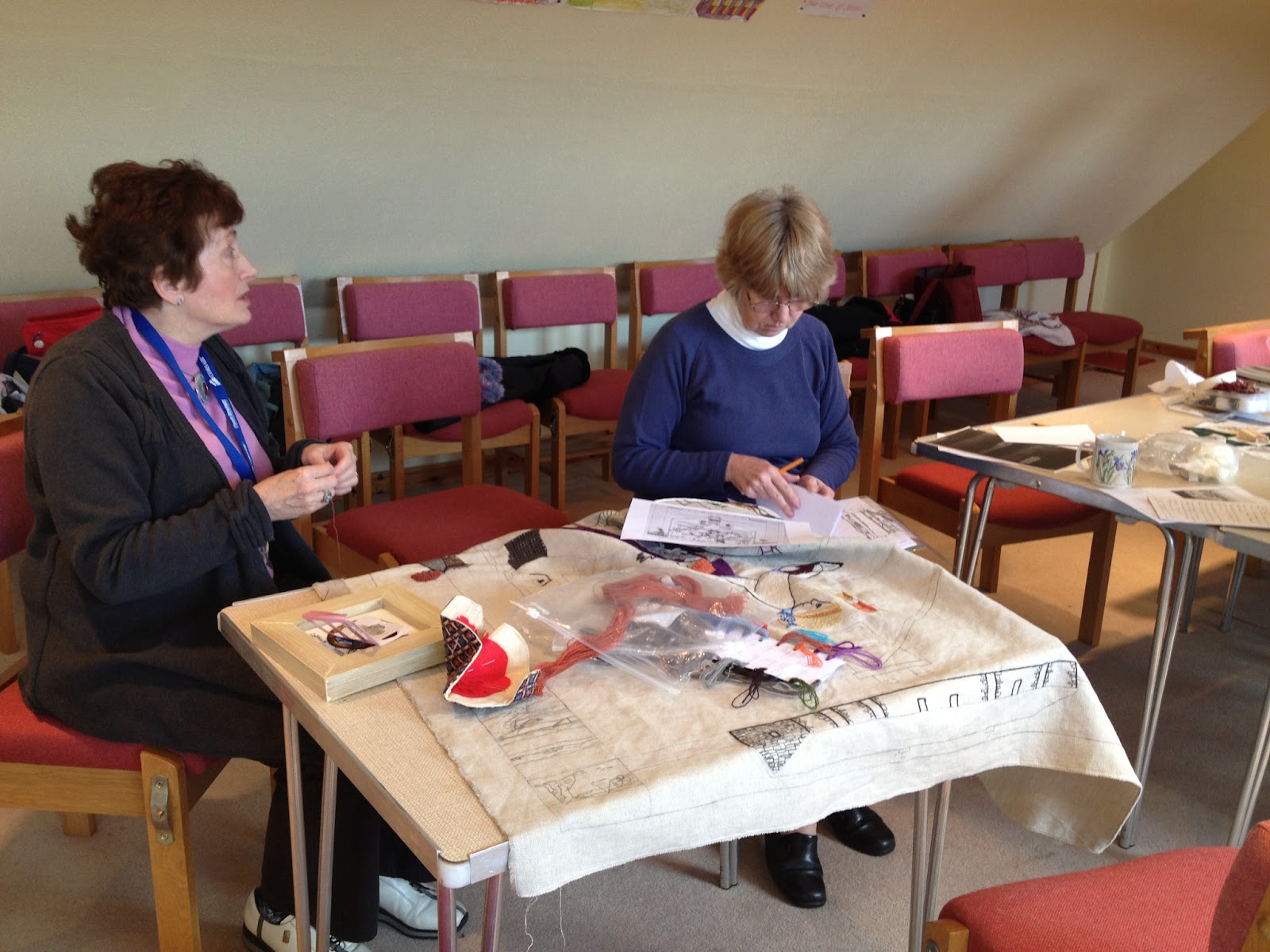
Our group meet in the top room of Pultneytown Parish Church. It is a wonderful room for close work as the light is good. Its small enough to warm up quickly and the facilities are extremely well kept. Over the past 3 months our Minister Stuart Farmes has been popping up to see our progress and has been a source of encouragement. This week we got a needle in his hand and he put a stitch in our panel.
This panel has its own history and its own story to add to the scene we are depicting. We've had visitors from Australia, America and now our own Minister has added a stitch.
Dolly has more fleece on her. She has so many French Knots Celia lost count of them.
Joan has been watching the Hen Harrier's from her sitting room window and now we have our own on the panel. This is the female which has a distinctive plumage. They have 'red' status on the RSPB site as there are endangered.
We couldn't possibly have a panel from Caithness without a boat. Its such an important part of the heritage it would be impossible to discount it. In the latter 1800's Wick was one of the biggest herring ports in the world and the coastline of Caithness has numerous harbours. This was a typical boat of the 1850s which Dorothy stitched.
The group all working on the panel at the same time.
Thursday, 13 June 2013
Dolly the Sheep
Meet Dolly.
Celia has been filling in the bottom left square with a sheep. This reflects Caithness farming community and the sheep of the time would have been an important industry both for the meat and the fabric it produced.
The tables have all the names embroidered on and seeded. There are even more on the lips of the tables. Note the bird on the top left.
Catherine has enhanced the blue of the sea around 'Chinad' the herring seller. You can see Shirley working on the Stacks of Duncansby square.
Celia has been filling in the bottom left square with a sheep. This reflects Caithness farming community and the sheep of the time would have been an important industry both for the meat and the fabric it produced.
The tables have all the names embroidered on and seeded. There are even more on the lips of the tables. Note the bird on the top left.
Catherine has enhanced the blue of the sea around 'Chinad' the herring seller. You can see Shirley working on the Stacks of Duncansby square.
The Schools are named
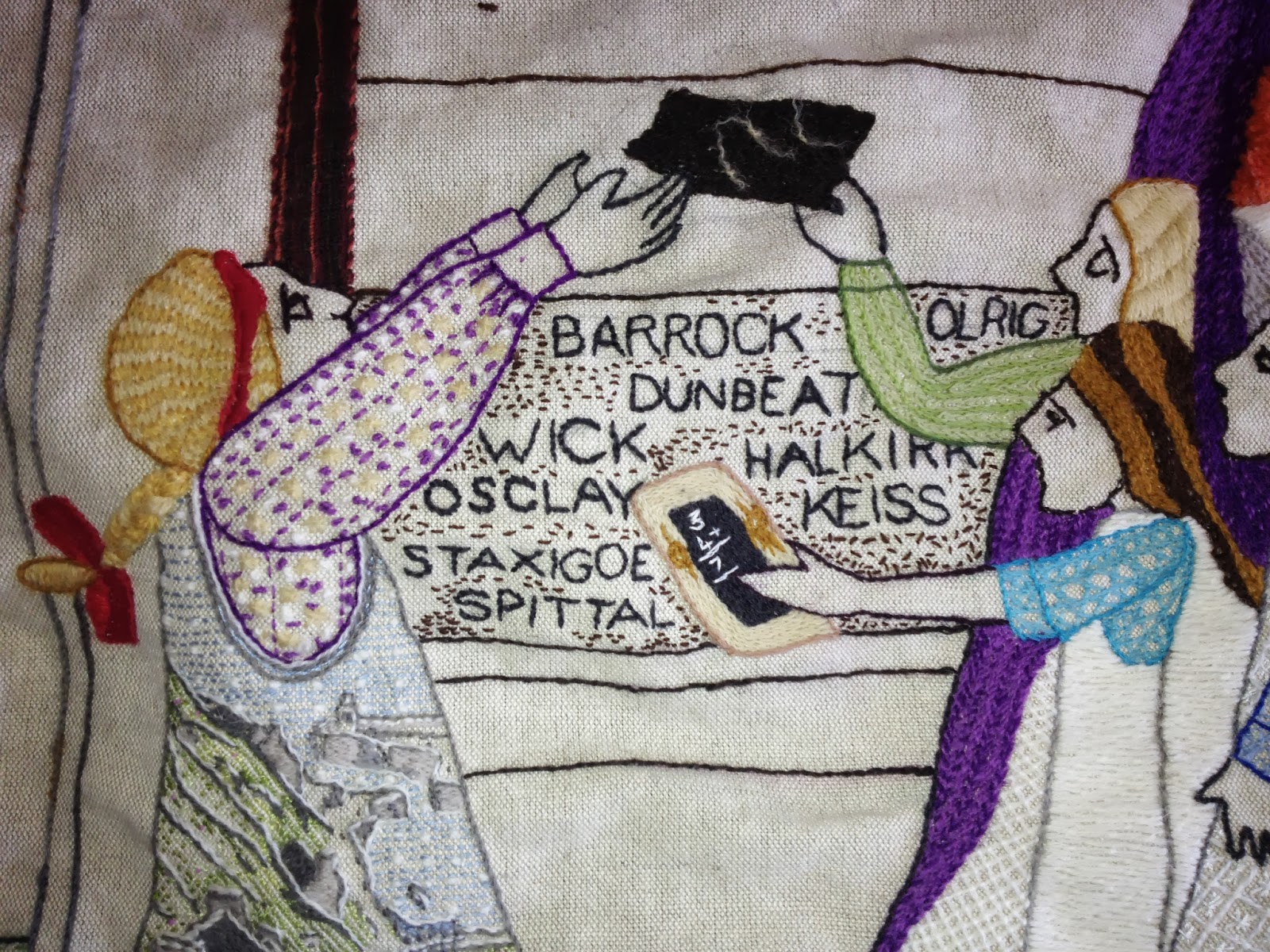
Valerie took the panel and wrote the names of the schools recorded in Caithness in 1851. There are a couple of place names where the spelling has changed from then to now but we have double checked them.
Joan then stitched them in a Quaker and back stitch mix. The hard part was the curves but as you can see Joan managed fine.
At the Tuesday sewing morning Joan, Louise and Valerie sat around the table and seed stitched the tables whilst Catherine stitched the roof of the school.
Joan also stitched 'Cissy's' slate using a long and short stitch and then over embroidered it with stranded cotton.
Louise took it home and completed the seed stitching on the top of the tables. She found her old embroidery stand which her daughter uses as a play dragon.
Joan then stitched them in a Quaker and back stitch mix. The hard part was the curves but as you can see Joan managed fine.
At the Tuesday sewing morning Joan, Louise and Valerie sat around the table and seed stitched the tables whilst Catherine stitched the roof of the school.
Joan also stitched 'Cissy's' slate using a long and short stitch and then over embroidered it with stranded cotton.
Louise took it home and completed the seed stitching on the top of the tables. She found her old embroidery stand which her daughter uses as a play dragon.
Monday, 27 May 2013
Chimneys and Peats
The school has walls, roof and chimney now. Catherine and Louise spent approx 15 hours Quaker stitching the building walls and chimney.
Louise has been taking a few more photos of chimneys in Caithness and tried to echo the roof.
Catherine stitched the Peats. The children had to pay to go to school and sometimes they would be able to pay with Peat. This would have been in the open fire in the school room and the smell of the peat would have been lovely.
Louise has been taking a few more photos of chimneys in Caithness and tried to echo the roof.
Catherine stitched the Peats. The children had to pay to go to school and sometimes they would be able to pay with Peat. This would have been in the open fire in the school room and the smell of the peat would have been lovely.
Friday, 10 May 2013
Dorie came to visit
The group met up with Dorie Wilkie the head embroiderer of the project. She came up to Thurso and we met at the Pentland Hotel along with another 2 groups from the area. The tea and scones were lovely.
She took up a completed panel and the group fell upon it with wonder. I won't put up photos as I've not asked permission of the stitchers but direct you instead to the Great Scottish Tapestry Facebook Page where you can go view without being a member of Facebook. There have been some more completed panels this week which are well worth going to look at.
It gave our group some inspiration on how to stitch on our panel. Also Dorie was a wealth of suggestions and experience. We asked her what she liked about our panel and what areas she would improve which we've taken on board.
Shirley had completed her top corner which is the Duncansby Stacks from the very tip of the North East coast of Scotland. We liked how the colours subtly reflected the fisherwoman on the bottom corner.
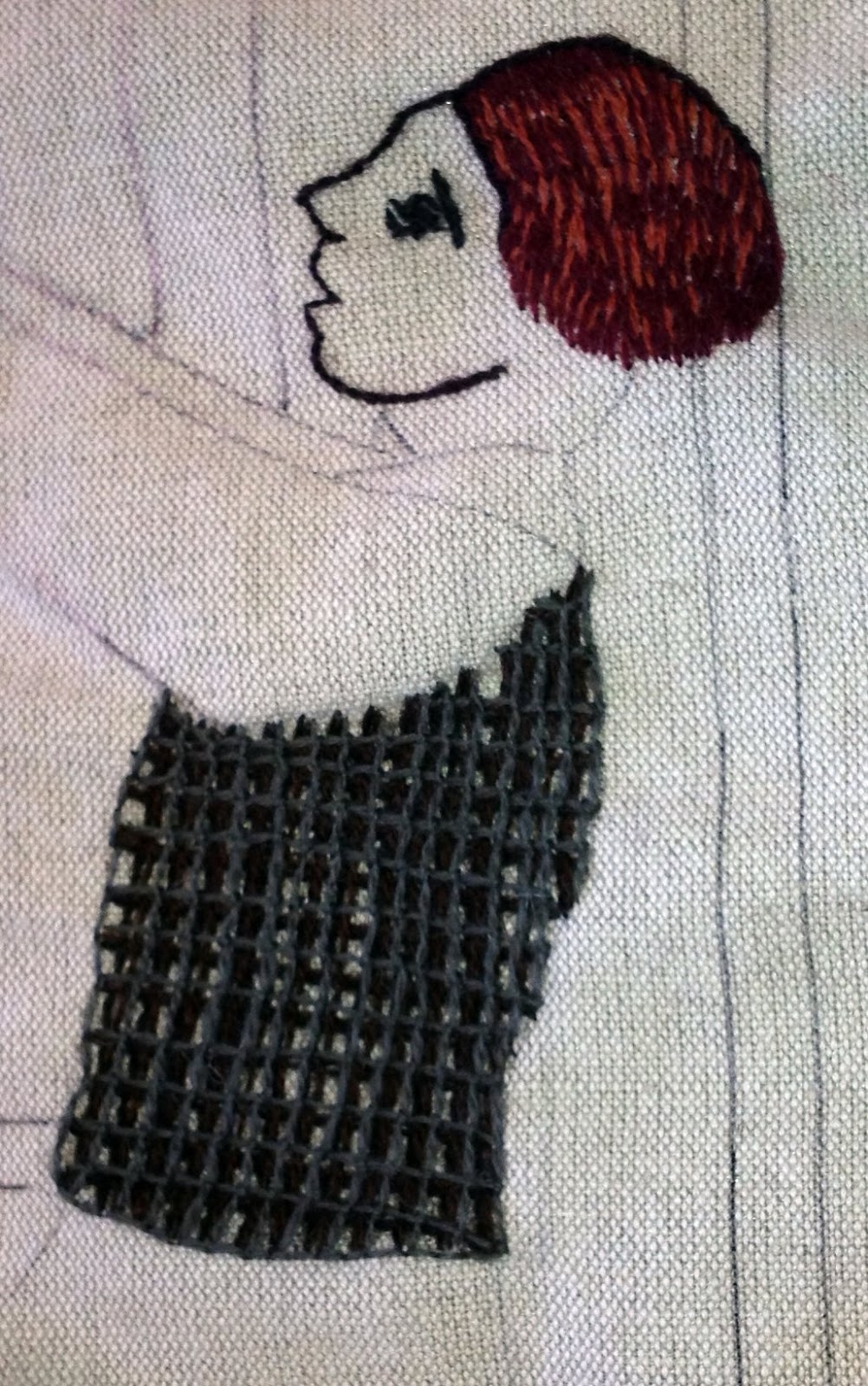
Joan has completed James the ministers son's trousers.
Ella finished the thatch on the long house. She used long laid couching in various layers and colours.
The blackboard has been sewn and the desk outline defined.
The panel as of 6 May 2013.
Louise has been taking note of chimneys around the county for the school chimney.
She took up a completed panel and the group fell upon it with wonder. I won't put up photos as I've not asked permission of the stitchers but direct you instead to the Great Scottish Tapestry Facebook Page where you can go view without being a member of Facebook. There have been some more completed panels this week which are well worth going to look at.
It gave our group some inspiration on how to stitch on our panel. Also Dorie was a wealth of suggestions and experience. We asked her what she liked about our panel and what areas she would improve which we've taken on board.
Shirley had completed her top corner which is the Duncansby Stacks from the very tip of the North East coast of Scotland. We liked how the colours subtly reflected the fisherwoman on the bottom corner.
Joan has completed James the ministers son's trousers.
Ella finished the thatch on the long house. She used long laid couching in various layers and colours.
The blackboard has been sewn and the desk outline defined.
The panel as of 6 May 2013.
Louise has been taking note of chimneys around the county for the school chimney.
Monday, 22 April 2013
Peats, Thatch and Hair
Ella has started the thatch roof of the long croft house. She has heavily researched the colours, the layout and the texture of thatch roofs and is using a long split stitch and a open stem stitch. This is in several colours as thatch has lighter top layers as the sun bleaches it.
In the panel the children are holding up peat to the teacher. Peat was the main fuel for Caithness as there are no coal mines or major woodland in the county and more expensive to be imported. Peat would be cut using a special tool and is hard back breaking work.
Catherine had in 2 rectangles of peat and told us that one was dry and hard and the other a bit damp and was called 'douwphy'. They would be broken up to put into the fire using the heel of a foot and then they became a clod.
She said that when her father cut the peats they would be laid flat on the bank. Then they when they were nearly dry they were lifted and put into a herring bone pattern on their edge and had to face the hill Morven which is in the south of the county. This would enable the wind to blow through the peats and dry it out ready for burning.
Ella said it was the same with the Stooks when they were cut and arranged in facing south to dry out.
Monday, 15 April 2013
Wick Stitch
The first three side panels have been drawn.
The panel on the right depicts Duncansby Stacks which are sea stacks to the very north east of the county. The panel below it depicts a typical Caithness harbour of the time.
Shirley was researching the stitches and colours for the Stacks.
It was agreed that the time spent doing research was very important to get the stitcher's mind set in the right place and to make sure that the stitches reflect the object being worked on.
Ella and Louise agreed that the project has been really good to find out the finer points of the history of Caithness.
Dorothy & Valerie discuss the Quaker Stitch.
Subscribe to:
Posts (Atom)